Services
Agency applications that carry the actual work.
Systems for government agencies: case handling, service delivery, data verification, performance reporting, and public transparency portals — several of them already running on official regency domains.
Local Government Applications
Agency work is rarely uniform. A social affairs office handles aid applications, beneficiary verification, supported business groups, and violence cases whose files are confidential. Another handles corporate CSR programmes, waste levies, or kitchen operations. Generic software rarely fits any of them.
What I build follows the regulation and the bureaucratic flow already in force: submission through completion, staged verification, separation of authority between agencies, and reporting in a format that was decided elsewhere. All of it has technical consequences — above all for permissions and confidentiality.
In SIKSCB, for instance, the UPTD PPA module handling violence against women and children has its own role, its own dashboard, its own access log, and data kept apart from general beneficiary records. That is not an added feature; it is the condition for the application being usable at all.
Scope
What the work covers.
Service delivery & case handling
Submission, acceptance, processing, and completion workflows with a status log at every stage. For sensitive cases: risk assessment, staged case plans, companion assignment, referral, and per-case access logging.
Data verification & synchronisation
Cross-checking between registers to establish eligibility, run as queued batch processes producing proposals that can be reviewed before they are adopted.
Planning & performance reporting
Government affairs, programmes, activities, sub-activities, and budget documents; indicator targets against monthly realisation, including definitive and planning amendments.
Multi-party coordination
Separate workspaces for administrators, agencies, and external parties such as companies — each seeing and doing only their own part, with verification in between.
Public transparency portal
Public pages with programmes, realisation figures, statistics, and ticket-code tracking for proposals or public reports — including anonymous reporting where the service demands it.
Security & audit trail
Per-action permissions, two-factor authentication, a security centre, activity logs, and audit trails. For confidential data: role separation and a record of who opened which file.
Evidence
Systems already running.
Not mockups — every one of these was built, handed over, and is used daily.
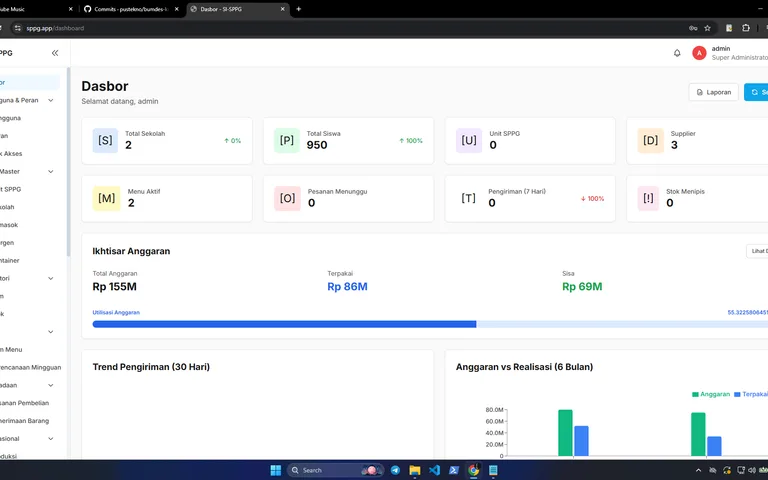
SI-SPPG — MBG Kitchen Operations (Go + React)
A Go and React operations system for Satuan Pelayanan Pemenuhan Gizi: weekly menus, procurement, inventory, production and quality control, distribution, budgets, complaints, and a public transparency portal.
Go 1.24 · Fiber 2 · GORM · PostgreSQL · +15
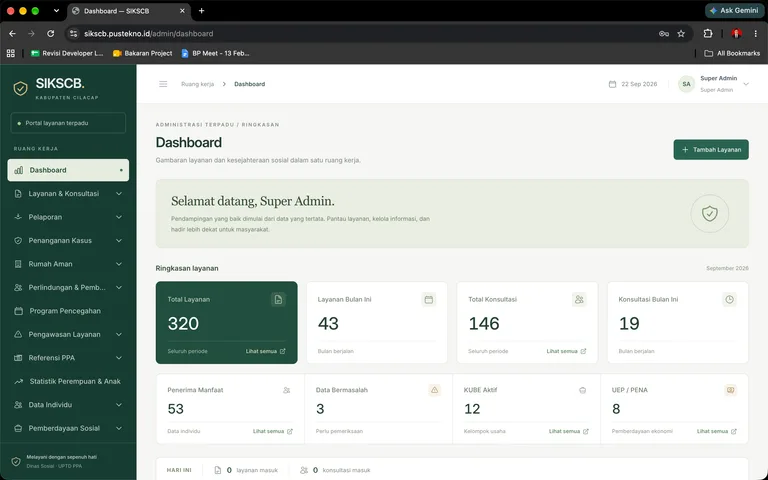
SIKSCB — Social Welfare & UPTD PPA Case Management
An integrated application for the Cilacap Regency social affairs and women & child protection offices: welfare services, violence-case handling with safe houses, social-key data synchronisation, assets, and performance planning.
Laravel 13 · PHP 8.4 · Blade · Livewire · +15
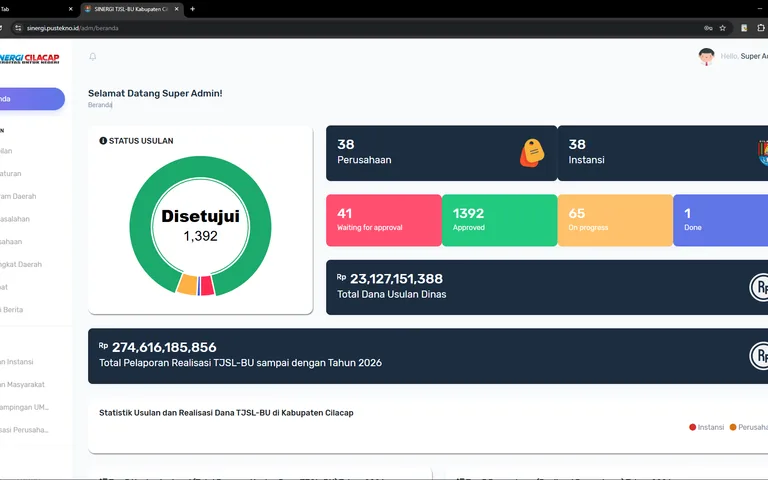
Sinergi Cilacap — CSR/TJSLBU Management
A CSR/TJSLBU management platform for Cilacap Regency connecting proposals from government agencies and the community with companies, activity delivery, and implementation reporting.
CodeIgniter 3 · PHP 8.1 · MySQL 8 · mPDF · +3
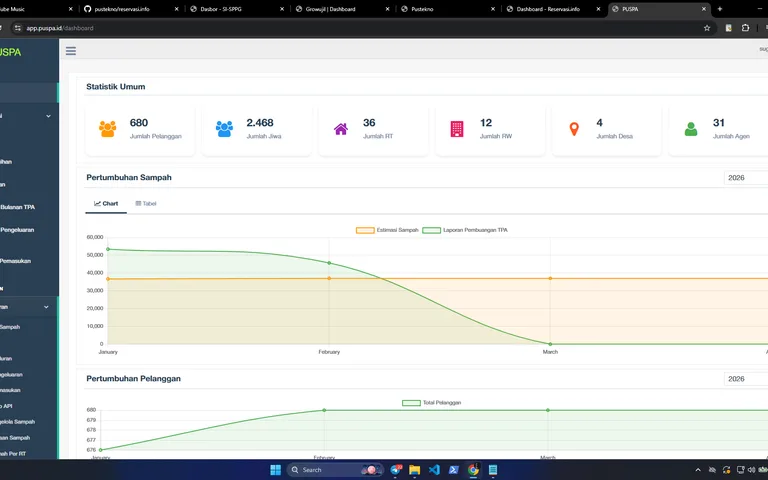
Puspa — Waste Banks & Service Fees
A regency-level waste-bank application: management units, customers, collectors, waste transactions, resident savings, service-fee bills, landfill reports, and regional dashboards.
Laravel 8 · Blade · MySQL · Laravel Sanctum · +7
How it works
From first conversation to handover.
- 1
Read the regulation and the flow
Before any code, I need to know which rules bind: report formats, verification stages, and who is authorised to approve what.
- 2
Map roles and confidentiality
Who may see what is decided up front, not afterwards. For sensitive data the separation is designed down to the database and the access log.
- 3
Build in stages
The module blocking the most work is built first, with something agency staff can test early.
- 4
Test with real records
Tested against real files, not samples — real cases always have shapes nobody imagined at design time.
- 5
Handover & support
Training per role, documentation, then support through the first reporting period, when most of the questions arrive.
Common questions
What people usually ask.
Can it be deployed on government-owned servers?
Yes, and that is the usual request. Several systems I have built run on regency go.id domains. Deployment, server configuration, TLS, and scheduled backups are part of the work.
How is confidential case data handled?
By separation, not by hiding it in the interface. The case module has its own role, its own dashboard, data separated from general records, and every file opening recorded in a per-case access log. Public reports can be filed anonymously and tracked by ticket code without exposing the reporter.
Can it connect to central or other agency systems?
Yes, where an integration route exists — an API, scheduled file exports, or database access. Several of these systems exist precisely to cross-check their own data against other registers as a batch process.
What about procurement and paperwork?
I am used to working through a registered company, so procurement documents, contracts, and invoicing can follow the institution’s procedures. The detail depends on the procurement mechanism in use.
Services
Other services
Village Information Systems
Resident records, document services, mapping, and the village website in one system shaped around how a village office already works — rather than a workflow imposed on it.
ERP for Village Enterprises & Small Business
Sales, point of sale, multi-warehouse inventory, purchasing, and accounting in one system — built for village enterprises and small businesses that neither need nor can afford enterprise-scale ERP.
School & Learning Centre Applications
QR attendance, verified teaching journals, assignments, exams, and report cards for schools and community learning centres — designed so administrative work shrinks rather than gains another application.
Contact
Tell me what you need to build.
Tell me about the system you need to build, the people who will use it, and the work it has to support. WhatsApp is fastest; I reply to every message.
Based in Purwokerto, Central Java. Working with clients across Indonesia, remote or on site.