Services
An ERP sized for the business that runs it.
Sales, point of sale, multi-warehouse inventory, purchasing, and accounting in one system — built for village enterprises and small businesses that neither need nor can afford enterprise-scale ERP.
ERP for Village Enterprises & Small Business
Most small businesses stall at the same point: sales recorded in one place, stock in another, and the books reassembled at month end from a pile of receipts. While turnover is small, that works. Add a second warehouse, a third employee, or marketplace sales, and the numbers stop agreeing with nobody able to say where the gap is.
An ERP at this scale exists to close that gap: one sale simultaneously reduces stock, records the receivable, and forms its journal entry. No double entry by hand, so no two departments can hold different numbers.
Jadiin.online runs this pattern in production across roughly 75 data models: sales, POS, an online store, purchasing, multi-warehouse stock with batch and serial tracking, full accounting, payroll, and assets. Payments use an interchangeable gateway layer — six are supported, chosen by whichever costs that business least.
Scope
What the work covers.
Sales & point of sale
Quotations, sales orders, invoices, delivery orders, and cashier transactions. An online store with catalogue, cart, checkout, customer accounts, and order history where it is actually needed.
Stock & warehouses
Inventory per warehouse with a stock movement recorded for every transaction, staged inter-warehouse transfers, batch and expiry tracking, barcodes, and label printing.
Purchasing & suppliers
Purchase orders with approval, goods receipt, payables, and transaction history per supplier.
Accounting
Chart of accounts, journals, posting, period locking, profit and loss, cash flow, general ledger, bank reconciliation, budgets, cost centres, and tax reporting.
Payments
An interchangeable gateway layer: Midtrans, Xendit, Doku, Tripay, Faspay, and Nicepay. Including manual transfer evidence with admin verification where customers are not used to paying online.
Reporting & profit sharing
Sales, inventory, daily profit, and product analytics. For village enterprises: cash books, monthly reports, accountability reports, work programmes, and profit-sharing calculations.
Evidence
Systems already running.
Not mockups — every one of these was built, handed over, and is used daily.
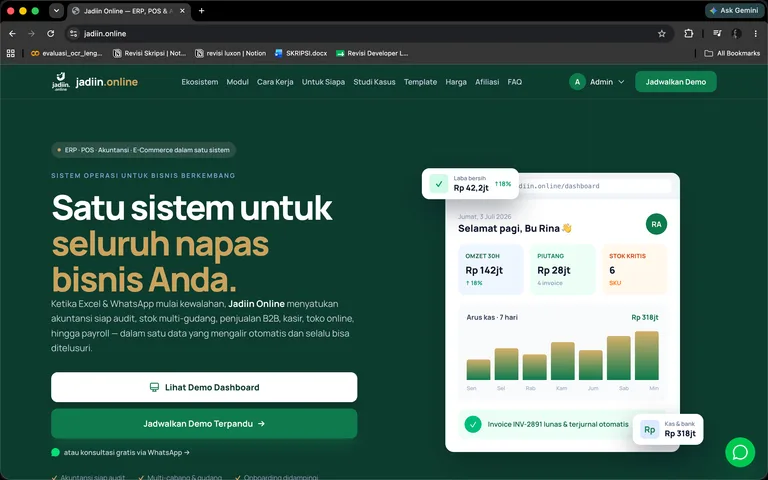
Jadiin.online — ERP, POS & Online Store
An ERP ecosystem with sales, POS, purchasing, multi-warehouse inventory, accounting, payroll, assets, a multi-gateway online store, and a customer portal for orders and product support.
Laravel 12 · PHP 8.2 · Blade · Tailwind CSS 4 · +16
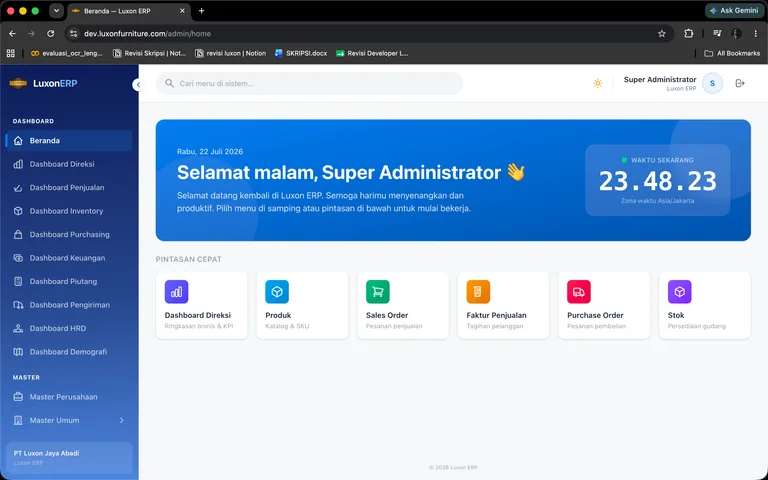
Luxon ERP — Trade & Distribution
A trade and distribution ERP with 150 migrations: pre-orders, container imports, warehouses, sales, accounting, HR, CRM, fleets, and deliveries in one workflow.
Laravel 13 · PHP 8.3 · Blade · Tailwind CSS 4 · +5
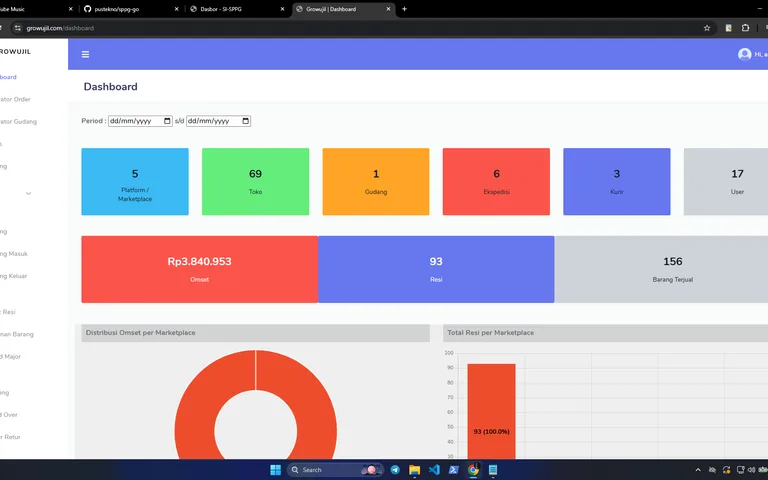
Growujil — E-commerce & Fulfilment ERP
A multi-store, multi-warehouse sales operations application: orders, inventory, pickups, shipping, returns, fraud cases, advertising records, and revenue and profit reports.
Laravel 11 · Laravel Breeze · Blade · Alpine.js · +6
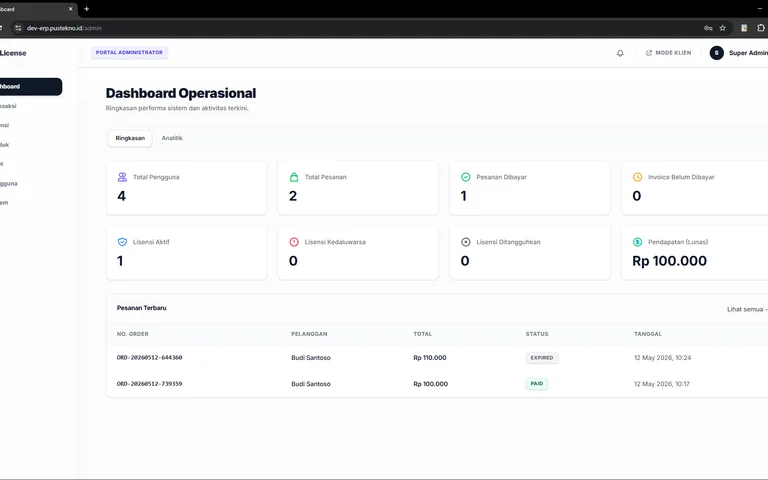
License Management — Software Distribution & Licensing
A software sales and distribution portal with licence activation, client validation, renewals, GitHub releases, Tripay payments, token-based downloads, and support tickets.
Laravel 13 · PHP 8.3 · Blade · Alpine.js · +5
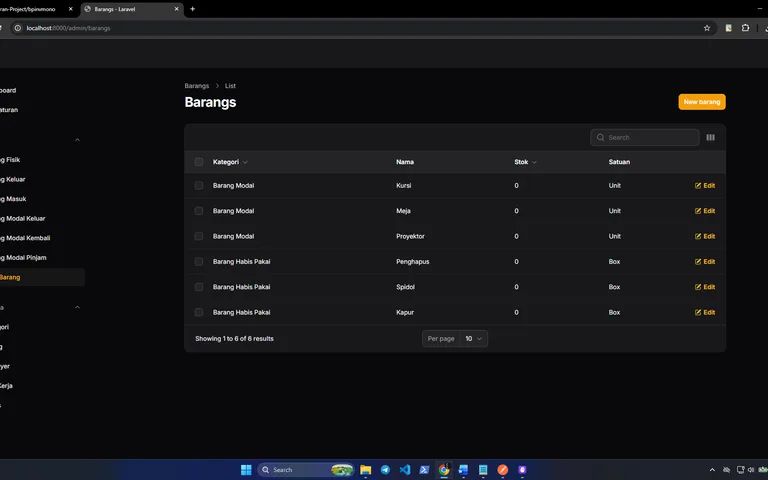
BPI Inventory — Stock & Asset Lending
A Filament inventory application for stock, incoming and outgoing goods, physical items, and capital-asset loans and returns by organisational unit.
Laravel 11 · Filament 3 · Livewire 3 · SweetAlert · +1
How it works
From first conversation to handover.
- 1
Look at the books as they are
The spreadsheet, cash book, or notes in use are the best starting point. They show what is genuinely recorded and what has been skipped.
- 2
Decide what is switched on
A full ERP is rarely needed on day one. Better to turn on what helps now and leave the rest for later.
- 3
Build in stages
Sales and stock usually come first because they are used daily; accounting follows once transaction data flows correctly.
- 4
Opening balances
Opening stock, cash, receivables, and payables are entered carefully. A mistake here is carried forever.
- 5
Handover & support
Cashier and admin training on their own data, then support through the first month-end close.
Common questions
What people usually ask.
Does the ERP have to be complete from the start?
No, and it is better if it is not. Switching everything on at a business not yet used to recording things is how systems get abandoned. Usually sales and stock first, accounting once the transaction flow is clean.
Does it work for a village enterprise with several business units?
Yes. The pattern of one entity with units beneath it is something I have built for a regency-wide village enterprise portal, with per-unit cash books, monthly reports, accountability reports, work programmes, and profit sharing.
What about marketplace sales?
Orders from multiple stores and platforms can be consolidated into one operational flow — that is what Growujil does, including pickups, shipping, returns, and receipt summaries by courier and platform.
Which payment gateway should we use?
It depends on per-transaction cost and what your customers actually use. Because the gateway layer is interchangeable, switching provider later does not mean rewriting the payment flow.
Services
Other services
Village Information Systems
Resident records, document services, mapping, and the village website in one system shaped around how a village office already works — rather than a workflow imposed on it.
Local Government Applications
Systems for government agencies: case handling, service delivery, data verification, performance reporting, and public transparency portals — several of them already running on official regency domains.
School & Learning Centre Applications
QR attendance, verified teaching journals, assignments, exams, and report cards for schools and community learning centres — designed so administrative work shrinks rather than gains another application.
Contact
Tell me what you need to build.
Tell me about the system you need to build, the people who will use it, and the work it has to support. WhatsApp is fastest; I reply to every message.
Based in Purwokerto, Central Java. Working with clients across Indonesia, remote or on site.