Jadiin ERP — 63-Module ERP Sold with Source Code
The main product of Jadiin Online: an ERP for distributors, importers, and business groups, with multi-warehouse stock, B2B documents from quotation to invoice, approvals, accounting, tax, payroll, POS, an online store, and 22 industry modules. 63 modules, sold once with the source code.
Screenshots
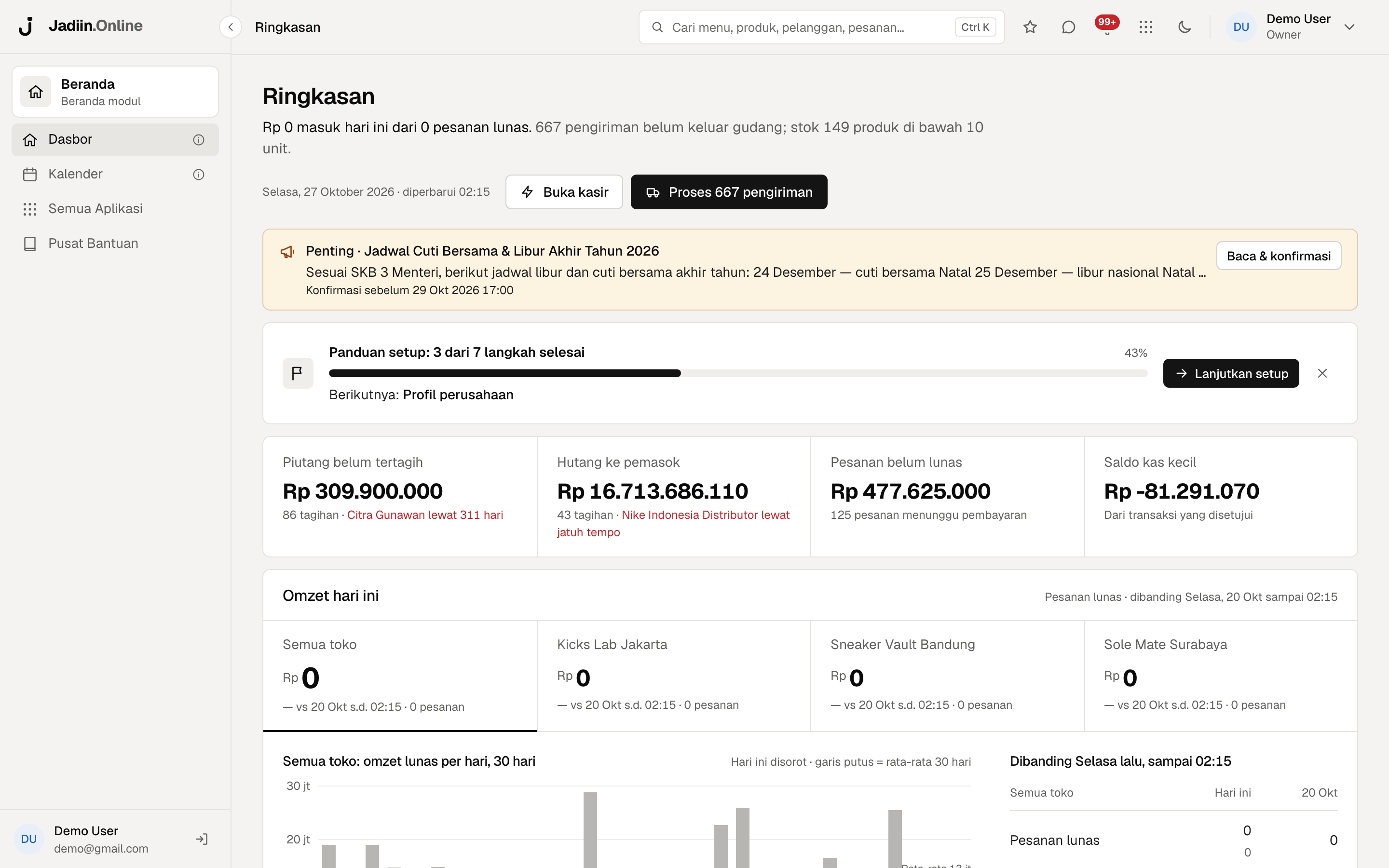
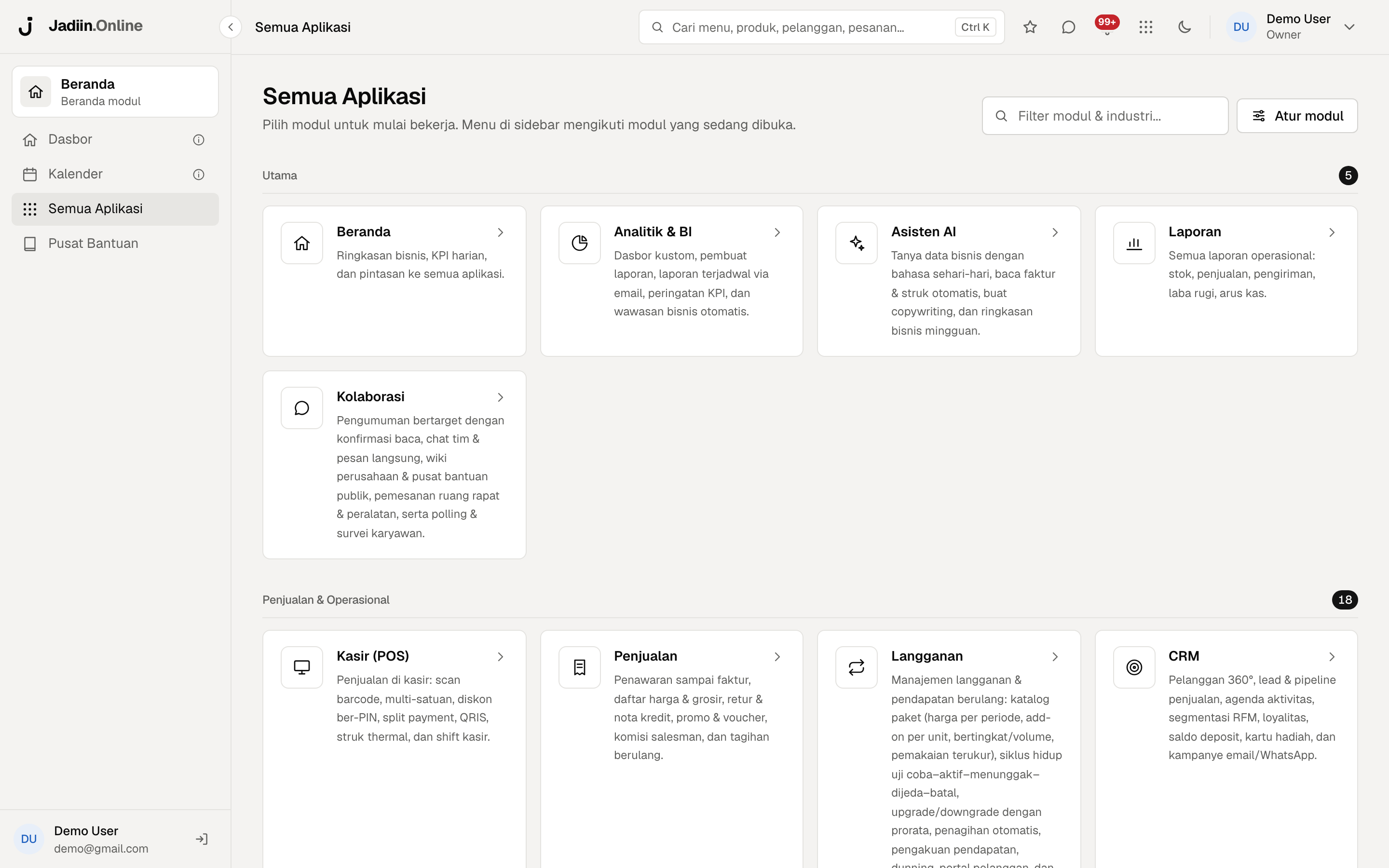
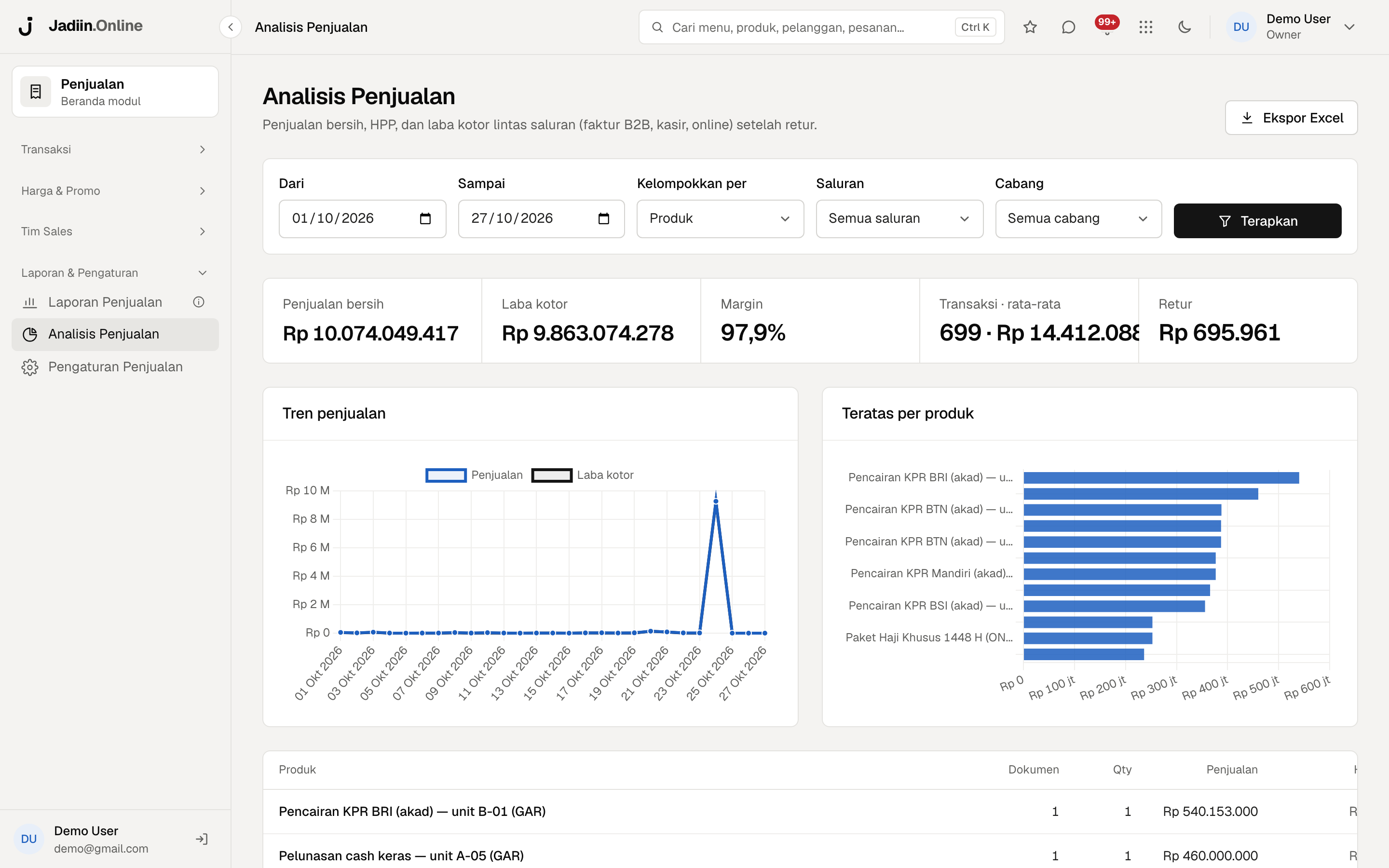
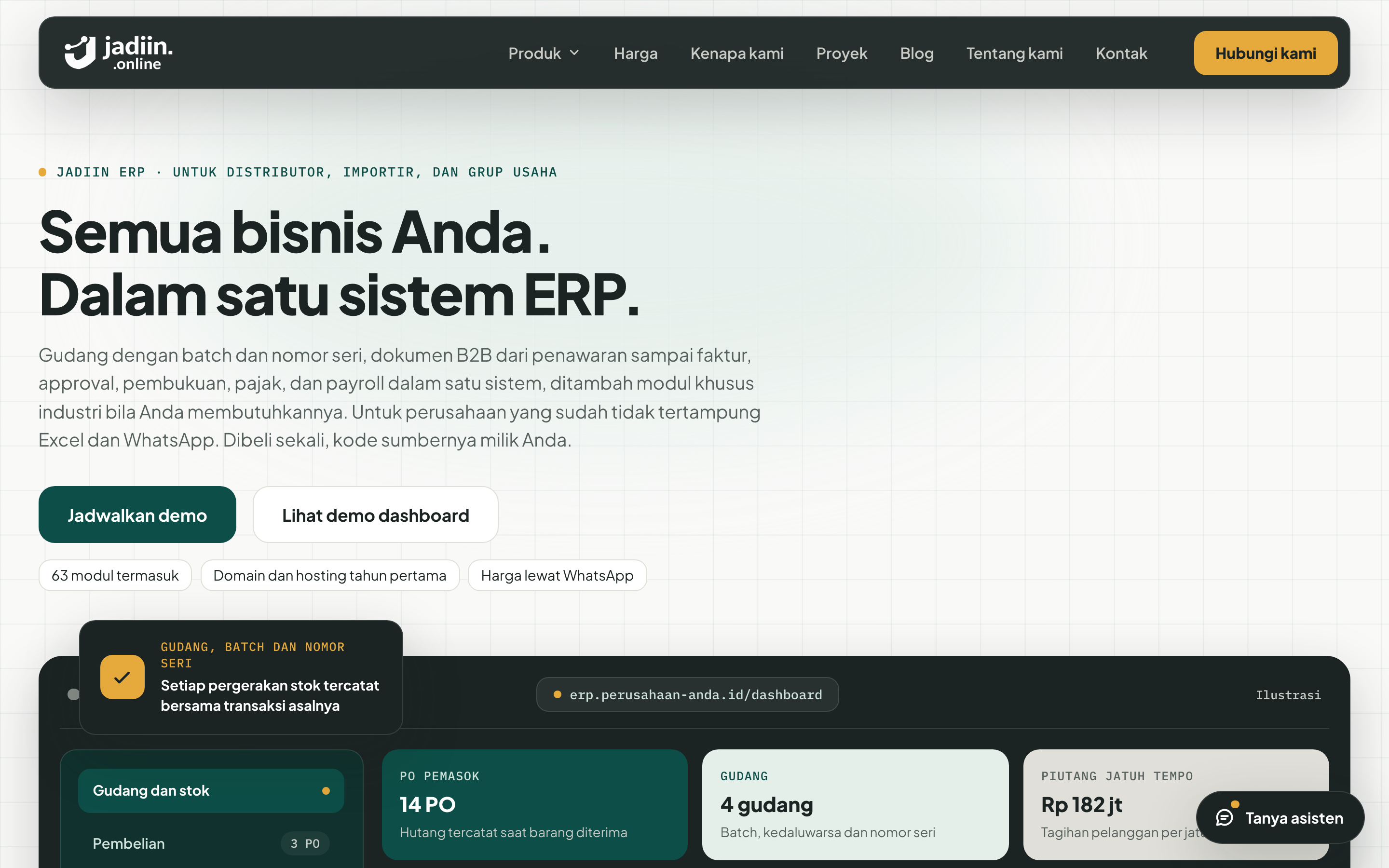
Overview
What this system does.
Jadiin ERP is the main product of Jadiin Online. It is an ERP for distributors, importers, and business groups that have outgrown spreadsheets and WhatsApp. Each buyer gets the full source code and their own instance and database, installed on a domain with the first year of hosting included; monthly maintenance is optional. The first client, PT Luxon Jaya Abadi, runs a version adapted for furniture import and distribution.
The system has 63 modules that can be switched on or off. Six are core: home, approvals, analytics and BI, an AI assistant, reports, and collaboration. Eighteen cover sales and operations, including sales, purchasing, inventory, advanced warehouse management, POS, the online store, marketplace, CRM, logistics, and fleet. Four cover finance (accounting, finance, tax, and fixed assets), eight cover people (HR, payroll, the employee portal, projects, OKR, e-learning, field service, and business travel), and five are system modules. The other 22 serve specific industries, from pharmacies, clinics, and restaurants to construction, cooperatives, schools, and Umrah travel.
Each document is created from the one before it: purchase order, goods receipt, sales order, delivery note, and invoice. Stock movements and journal entries are posted in the same transaction. Access is controlled by roles and field-level permissions for sensitive data such as cost price and salaries, with multi-level approvals, an audit trail, and two-factor or Google sign-in. Payments use one gateway interface with Midtrans, Xendit, Doku, Tripay, Faspay, and Nicepay behind it, and the online store shares warehouse stock and offers 50 themes. The AI assistant is built on the Anthropic SDK. The codebase has about 1,190 data models and 361 migrations. I wrote most of the code; co-founder Subani Charis Prasetya also contributed.
Feature inventory
Highlights
25 capabilities verified against the project source.
Sales, POS, and online store
- Quotations, sales orders, delivery notes, and invoices created from one another
- POS that uses the same products and stock as B2B sales
- Online store with catalogue, cart, checkout, customer accounts, and 50 themes
- One payment interface with Midtrans, Xendit, Doku, Tripay, Faspay, and Nicepay
- RajaOngkir shipping rates at checkout
- Marketplace, consignment, subscription, and CRM modules
Purchasing and inventory
- Purchase orders with approval, ordering, receipt, and cancellation
- Stock per warehouse with a movement recorded for every transaction
- Transfers sent from one warehouse and received at the other
- Batch, expiry, and serial-number tracking with barcodes and labels
- Advanced warehouse management, logistics, and fleet modules
Finance and tax
- Double-entry accounting with journals, posting, and fiscal-period locks
- Financial statements, general ledger, and cash flow
- Bank reconciliation, budgets, cost centres, and multiple currencies
- Tax module that prepares documents for Coretax
- Fixed assets with monthly depreciation and maintenance records
People
- HR and payroll with PPh 21 and BPJS, approved before payment
- Employee portal, projects with Kanban boards, OKR, e-learning, and business travel
Industry modules
- 22 industry modules, such as pharmacy, clinic, restaurant, hotel, construction, cooperative, school, laundry, and Umrah travel
Control and insight
- Approval inbox with multi-level workflows
- Role and field-level permissions with an audit trail
- Two-factor sign-in with TOTP and Google sign-in
- Custom dashboards, a report builder, scheduled email reports, and KPI alerts
- Product analytics and sales forecasting per product
- AI assistant for questions about business data, invoice and receipt reading, and weekly summaries
Capabilities
What it is built to handle.
Implementation highlights documented in the project source.
- Modules
- 63
- Including 22 for specific industries
- Data models
- 1,190
- With 361 migrations
- Payment gateways
- 6
- Behind one interface
Tech stack
Built with 19 technologies.
- Laravel 12
- PHP 8.2
- Blade
- Alpine.js
- Tailwind CSS 4
- Vite 7
- Spatie Permission
- Spatie Media Library
- Spatie Backup
- Laravel Sanctum
- Laravel Socialite
- Google2FA
- Anthropic SDK
- DomPDF
- Maatwebsite Excel
- Redis
- Sentry
- Playwright
- MySQL
Common questions
What people usually ask.
How is Jadiin ERP different from satubiji?
satubiji is a cloud ERP that businesses subscribe to module by module on satubiji.com. Jadiin ERP is bought once with its source code, runs on the buyer’s own instance, and includes all 63 modules.
Why six payment gateways rather than one?
Because the cheapest gateway differs per business and per customer base. The payment layer is one interface with six implementations behind it, so switching provider is a configuration change rather than a rewrite of the checkout.
Does stock update by itself when a sale is recorded?
Yes. A sale writes the stock movement, the receivable, and the journal entry in one transaction. That single path keeps sales, inventory, and the books from disagreeing.
What are the industry modules for?
They add the workflows of a specific trade, such as patient visits for a clinic or checkrolls for a plantation. A company switches on only the ones it needs, and they use the same products, stock, and books as the rest of the system.
Same field
Related projects.
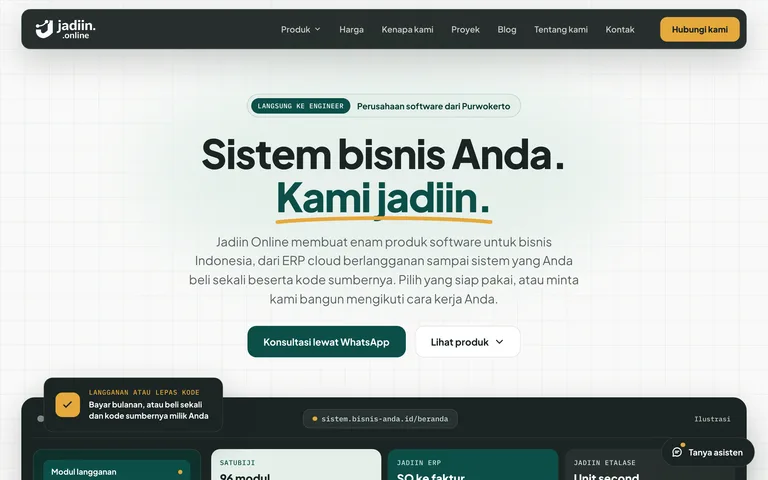
Jadiin Online — Business Software Company
The software company I founded with Subani Charis Prasetya. It makes six products — satubiji, Jadiin ERP, Jadiin Etalase, Jadiin Villa, Sistem SPPG, and Jadiin Distributor — sold by subscription or with their source code, and builds custom systems. jadiin.online is its product and sales site.
Laravel 12 · PHP 8.3 · Blade · Alpine.js · +13
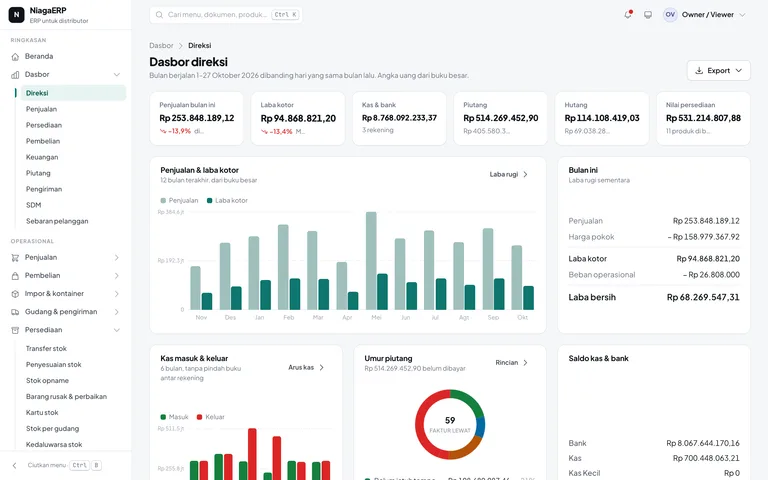
Jadiin Distributor — ERP for Distributors & Importers
A ledger-based ERP for distributors: quotations to invoices and payments, purchasing with three-way matching, container imports and pre-orders, multi-warehouse stock with batches and expiry, bank reconciliation, HR and payroll, CRM, fleets, and dashboards.
Laravel 13 · PHP 8.4 · Blade · Alpine.js · +5
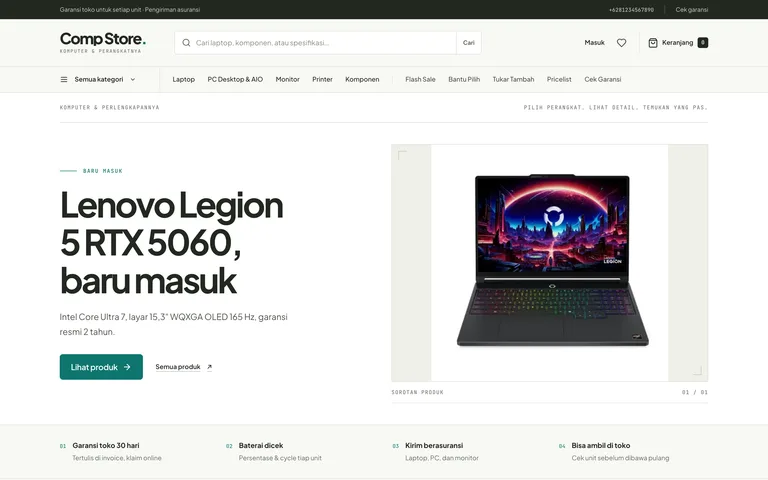
Jadiin Etalase — Online Store for Computer Shops
A Jadiin Online product for computer and electronics shops, sold once with its source code: catalogue with specification filters and a product finder, per-unit stock for second-hand laptops, written warranties with online claims, Midtrans and Tripay payments with deposits, shipping through Biteship or RajaOngkir, B2B levels, promotions, and per-unit profit reports.
Laravel 13 · PHP 8.3 · Livewire 4 · Tailwind CSS 4 · +5