ePres — Face Recognition Attendance Gateway for ASIS
ePres is Puskomedia’s attendance server. I turned it into the attendance gateway for ASIS schools: faces are recognised on the server, fingerprint machines are synced, and face data is sealed behind a PIN to meet Indonesia’s personal data protection law.
Screenshots
Overview
What this system does.
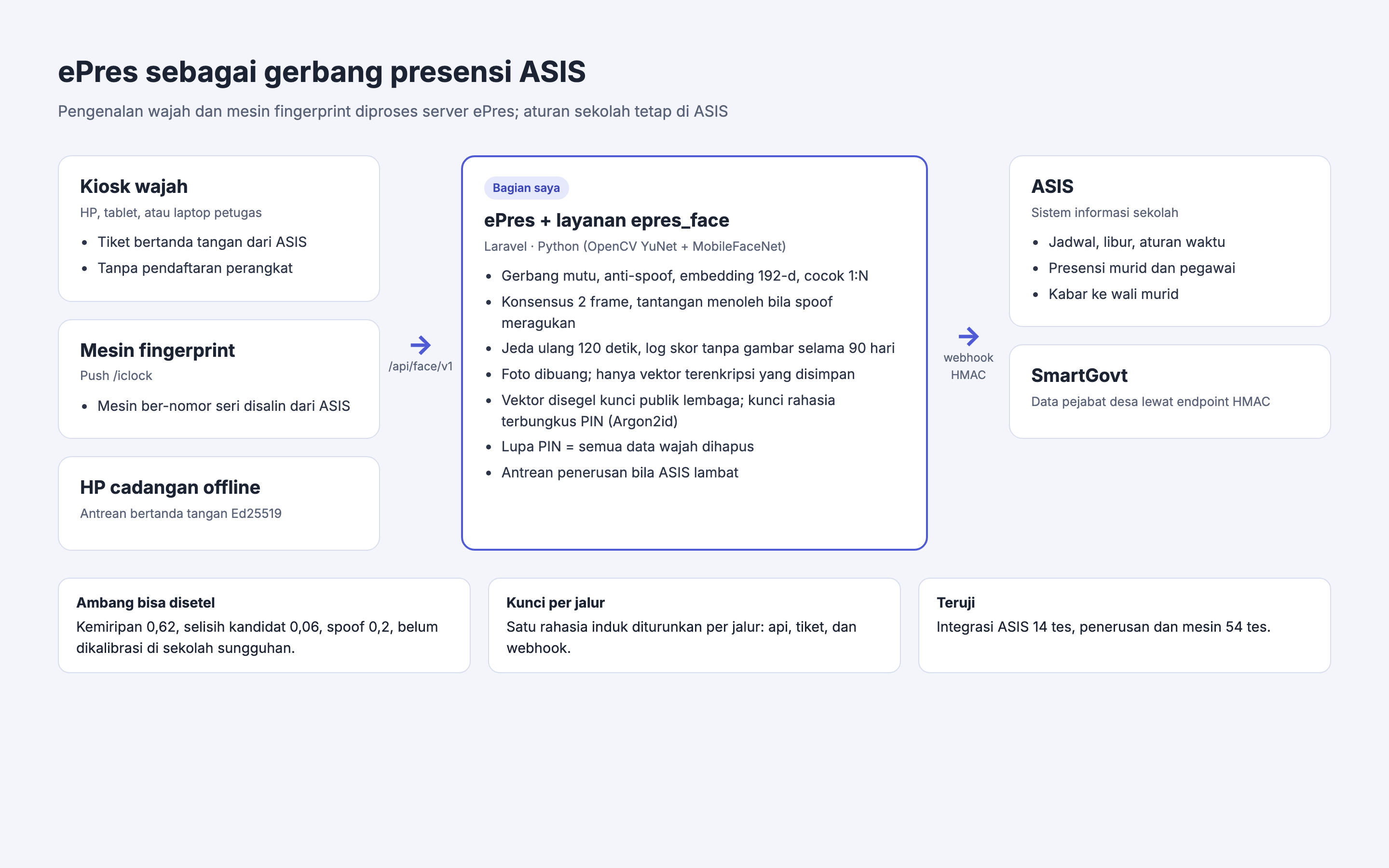
ePres at epres.id began as Presensi Panda, a Laravel application that records the attendance of village officials, built and maintained by a Puskomedia team that includes Zaenurrochman and Wahyu Aji Pangestu. My commits made it the attendance gateway for ASIS, the school information system. Face recognition and fingerprint machines now run on the ePres server, while ASIS keeps the school’s own rules: timetables, holidays, time windows, and messages to parents.
Recognition runs in a new Python service, epres_face, using OpenCV YuNet for detection and MobileFaceNet for 192-dimension embeddings, with the same anti-spoofing model as the ASIS app and tuned to run on a CPU without AVX. Any phone, tablet, or laptop signed in by school staff becomes a kiosk through a signed ticket from ASIS, with no device registration. A match needs agreement across two frames; when the spoof score is uncertain the kiosk asks the person to turn their head, checked against five facial landmarks. Rescans are blocked for 120 seconds, and every attempt logs its scores without any image for 90 days so thresholds can be tuned. Results are forwarded to ASIS, and queued when ASIS is slow to answer.
Photos are never stored, only encrypted vectors. Under Indonesia’s personal data protection law, those vectors are sealed with the institution’s public key, and its private key is wrapped by a PIN using Argon2id. The face gallery opens only with that PIN, exports are PIN-protected and compatible with the app, and a forgotten PIN means all face data is deleted. ASIS also syncs schools, fingerprint machines by serial number, and the public keys of offline backup phones whose queued scans are signed with Ed25519. A further endpoint gives SmartGovt the village officials’ data over HMAC.
Feature inventory
Highlights
16 capabilities verified against the project source.
Face recognition
- Face recognition on the server through a Python service with OpenCV YuNet and MobileFaceNet
- Quality gate, anti-spoofing, 192-dimension embeddings, and one-to-many matching
- Two-frame consensus and a turn-your-head challenge when the spoof score is uncertain
- 120-second rescan cooldown and score logs without images, kept for 90 days
Kiosks
- Kiosk API for identify, challenge, enrolment, enrolment list, and forgetting
- Any staff phone, tablet, or laptop as a kiosk through signed ASIS tickets
Biometric data protection
- Only encrypted face vectors stored; photos discarded
- Vectors sealed with the institution’s public key, private key wrapped by a PIN with Argon2id
- PIN-gated face gallery, PIN-protected exports, and full deletion on a forgotten PIN
Machines and sync
- Fingerprint machine pushes forwarded to ASIS for students and staff
- Schools and machines synced automatically from ASIS
- Offline backup phones whose queued scans are checked with Ed25519
- Forwarding queue that retries when ASIS is slow
Integration
- Per-channel keys derived from one shared secret for the API, tickets, and webhooks
- Village officials’ data for SmartGovt over an HMAC endpoint
- Thresholds configurable per environment, with tests for the ASIS integration and forwarding
Capabilities
What it is built to handle.
Implementation highlights documented in the project source.
- Photos stored
- 0
- Only encrypted face vectors
- Frames per match
- 2
- Plus a head-turn check when spoofing is uncertain
Tech stack
Built with 9 technologies.
- Laravel
- PHP
- PostgreSQL
- Python
- OpenCV (YuNet)
- MobileFaceNet
- Argon2id
- Ed25519
- Docker
Common questions
What people usually ask.
Why move face recognition from the phone to the server?
On the phone, every device needed the models and the enrolled faces. On the server, one place holds the encrypted vectors and the same checks apply to every kiosk, and any staff device can become a kiosk without setup.
How is biometric data protected?
No photos are kept. Vectors are encrypted with the institution’s public key, and the matching private key can only be unwrapped with a PIN. Without the PIN nobody, including the server operator, can open the gallery, and forgetting the PIN deletes everything.
What was already there?
ePres itself, the attendance records for village officials, fingerprint machine ingestion, and forwarding were built by the Puskomedia team. My part was the ASIS gateway, the face service, the biometric vault, and the SmartGovt endpoint.
Same field
Related projects.
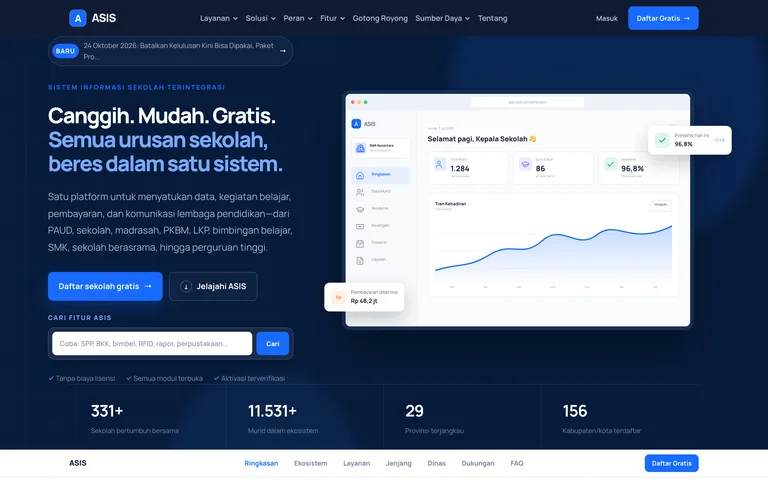
ASIS — School Information System Ecosystem
A free, multi-tenant school ecosystem with one account for every role: academics and Kurikulum Merdeka, exams, finance, student affairs, staff, school services, school websites, a mobile app, a digital library, and an interactive studio.
Laravel 13 · PHP 8.4 · Blade · Alpine.js · +7
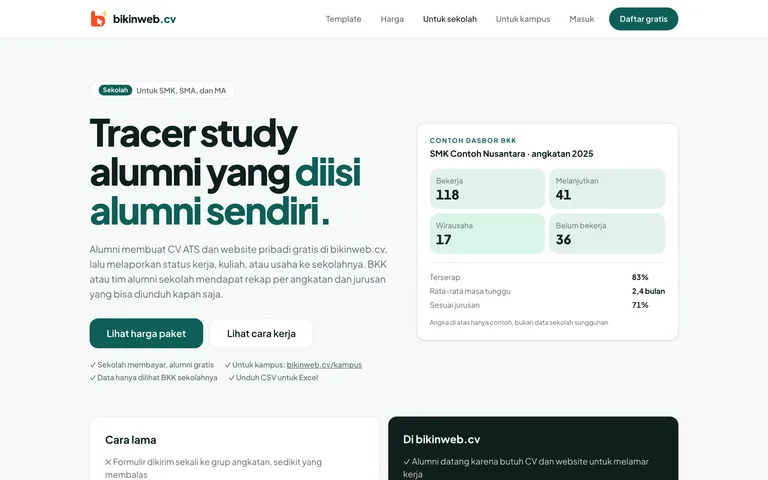
bikinweb.cv — Online CVs and Alumni Tracer Studies
A Jadiin Online product that turns one resume into a personal web page, ATS PDFs, and a QR code, and gives schools and campuses an alumni tracer study that their graduates fill in themselves.
Laravel 13 · PHP 8.4 · Tailwind CSS 4 · Alpine.js · +3
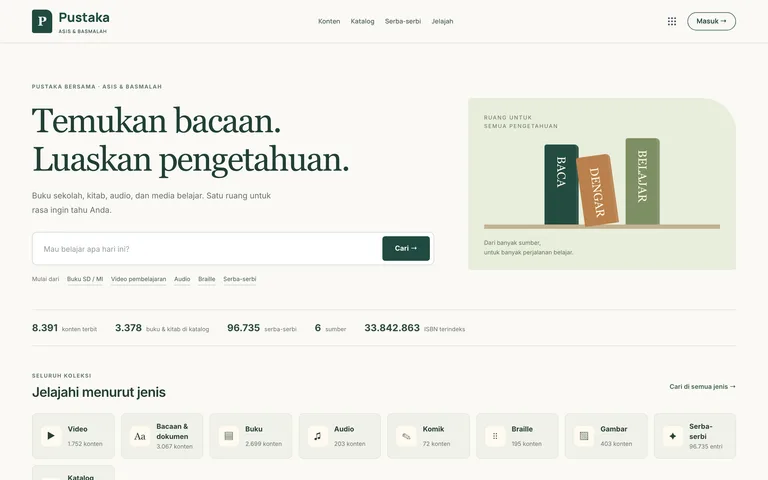
Pustaka ASIS — Digital Library, Teaching Kits & Question Bank
The content warehouse of the ASIS ecosystem: digital books, Kurikulum Merdeka teaching kits generated from learning objectives, a reviewed question bank with LaTeX and standard exports, and an ingest API for contributors.
Laravel 13 · PHP 8.4 · Blade · Alpine.js · +6