satubiji — Modular Business Suite (Go)
The subscription product of Jadiin Online: a business suite with 96 modules in 11 groups, where each module is bought on its own and shares data with the others — point of sale, inventory, attendance, payroll, accounting, tax, and more. Built as a single Go binary on PostgreSQL with row-level security and an event outbox.
See the service: ERP for Village Enterprises & Small Business
Screenshots
Overview
What this system does.
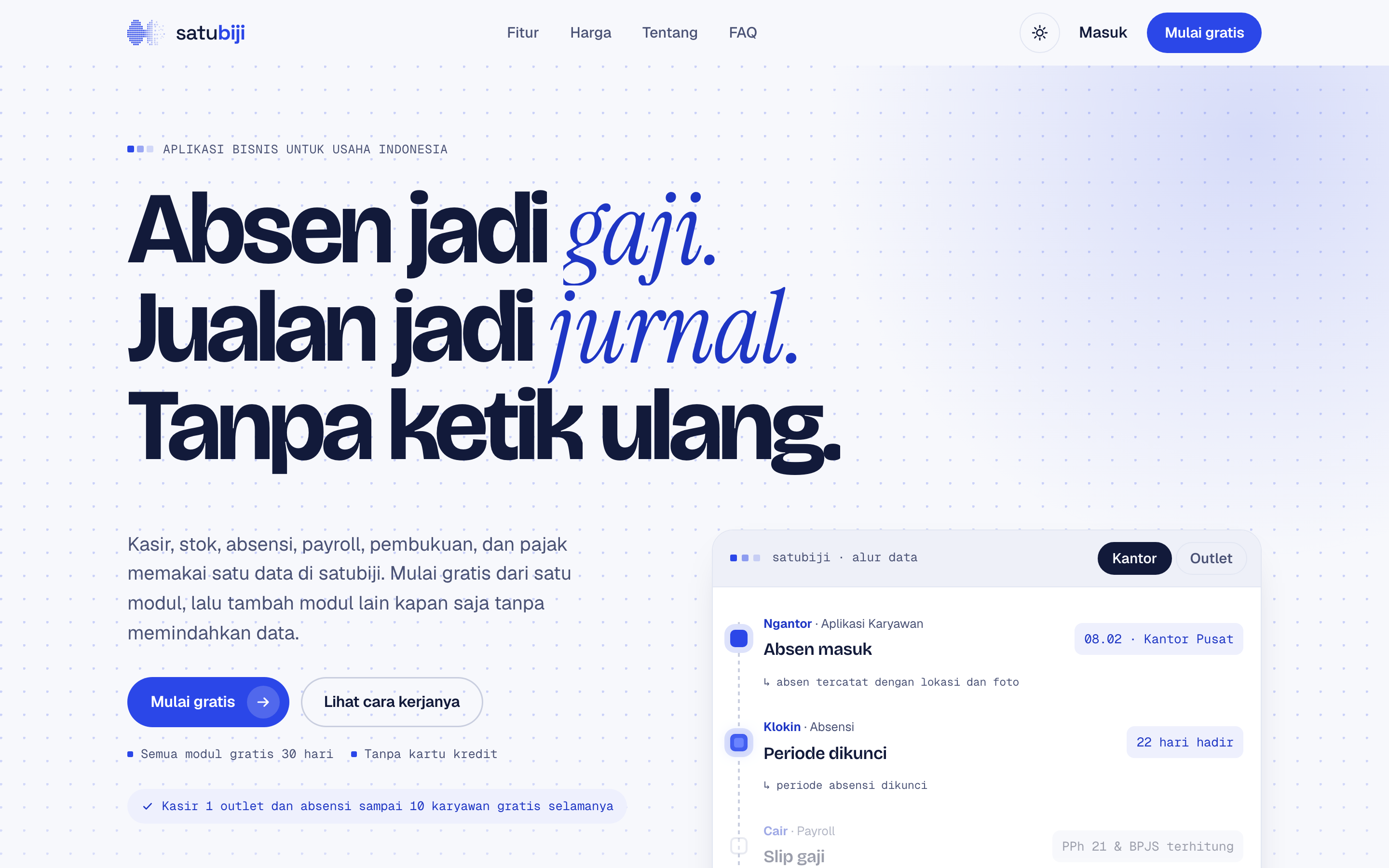
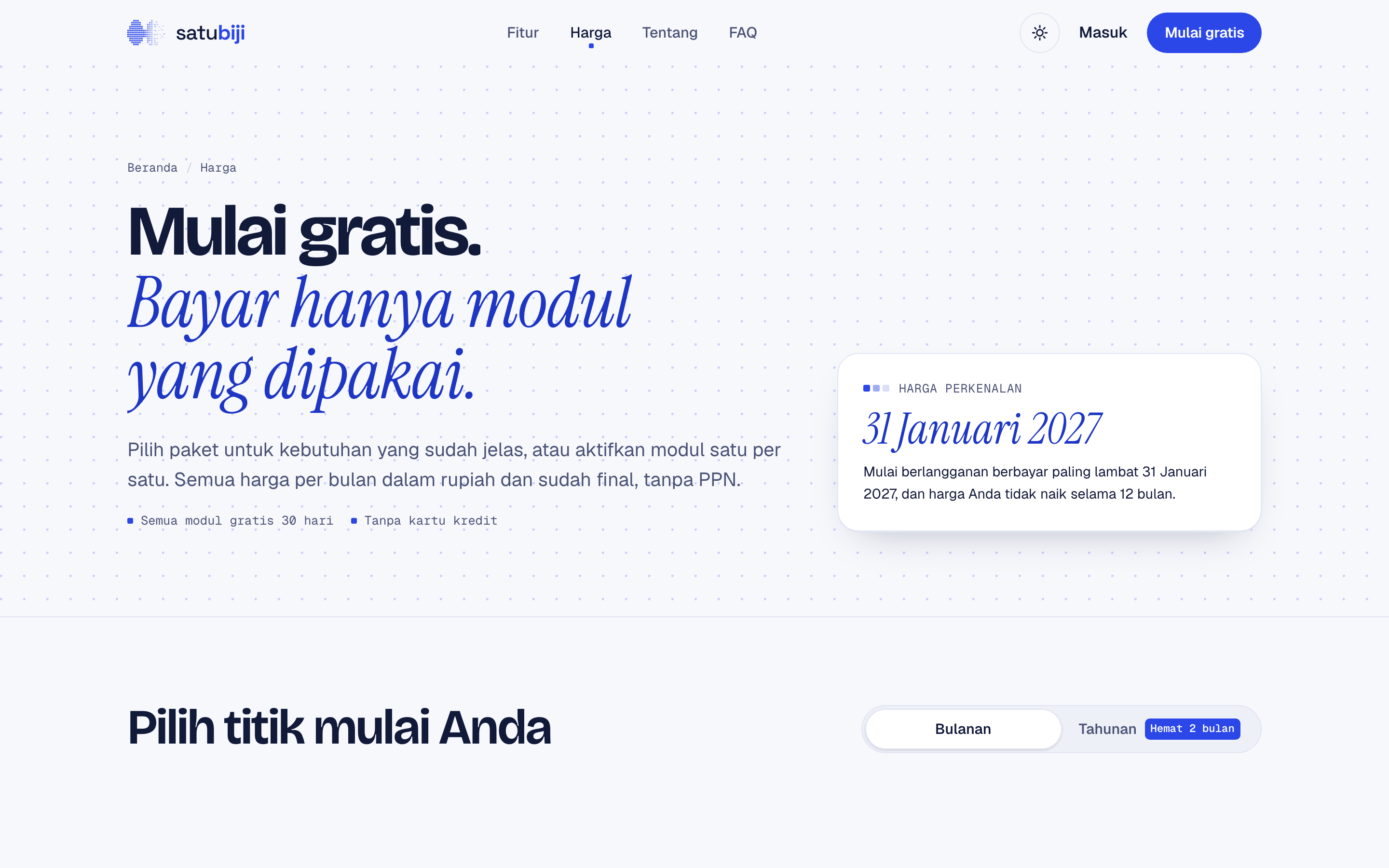
satubiji is the subscription product of Jadiin Online, the company I founded, for businesses that want to start from a single module. Businesses sign up themselves on satubiji.com, choose from 96 modules in 11 groups, and pay only for the modules they use. Every module can be tried free for 30 days without a credit card, and a till for one outlet plus attendance for up to ten employees stay free. Payroll follows the TER method for income tax and BPJS contributions, and tax documents are prepared for Coretax, all from dated parameters maintained by the satubiji team. I wrote most of the code; co-founder Subani Charis Prasetya also contributed.
satubiji lets a business start with one module — a point-of-sale till, attendance, payroll, or bookkeeping — and add others later without moving data. A check-in at the office closes into an attendance period, flows into payroll with income tax and social security, and posts its journal to accounting; a sale at the till reduces stock, earns loyalty points, and posts its own journal. Each module has its own short Indonesian name, from Cuan for the till and Klokin for attendance to Cair for payroll and Klop for accounting.
The backend is a single Go binary that serves the API, the web pages, the event relay, and the background workers. PostgreSQL is the only infrastructure: each module owns a schema, every table is protected by row-level security, events are written to an outbox in the same transaction as the change that caused them, and jobs run from a queue in the database. Store code is generated from SQL with sqlc, money uses exact decimals, and architecture tests check module boundaries, row-level security on every table, and permissions on every route.
The frontend is built with Astro and Preact, with installable apps for employees, owners, the till, and a face-recognition attendance kiosk. Production runs without Docker on a dedicated server: Caddy in front of two systemd instances of the binary, switched in turn during a release, with PostgreSQL behind them and a production mode that refuses development keys.
Feature inventory
Highlights
20 capabilities verified against the project source.
- 96 modules in 11 groups, each with a short Indonesian name
- Every module free for 30 days; one-outlet till and attendance for up to ten employees free
- PPh 21 TER, BPJS, VAT, and Coretax documents from dated parameters
- Export of all company data at any time
- Modules sold individually with shared data
- Attendance to payroll to accounting without re-entry
- Point of sale to inventory, loyalty, and accounting
- Income tax and social security in payroll
- Single Go binary for API, web, events, and workers
- PostgreSQL schema per module
- Row-level security on every table
- Transactional event outbox and database job queue
- Store code generated from SQL with sqlc
- Exact decimal arithmetic for money
- Architecture tests for module boundaries, RLS, and route permissions
- OIDC sign-in and one-time passwords
- Excel import and export
- Astro and Preact installable apps for employees, owners, and the till
- Face-recognition attendance kiosk
- Zero-downtime releases with two alternating instances
Capabilities
What it is built to handle.
Implementation highlights documented in the project source.
- Modules
- 96
- In 11 groups, bought one by one
- Day trial
- 30
- Every module, no credit card
- Go binary
- 1
- API, web, events, and workers
Tech stack
Built with 12 technologies.
- Go
- PostgreSQL 17
- pgx
- sqlc
- goose
- Row-Level Security
- OIDC
- Astro
- Preact
- PWA
- Caddy
- systemd
Common questions
What people usually ask.
What does “modular” mean here?
Each module can be bought and used on its own. When two modules are used together, their data connects automatically — attendance feeds payroll, payroll and sales post to accounting — without importing or retyping anything.
How is one company’s data kept apart from another’s?
Every table is protected by PostgreSQL row-level security, and architecture tests fail the build if a table is missing its policy or a route is missing its permission.
Why a single Go binary?
It keeps operations simple: one artefact serves the API, pages, event relay, and workers, and PostgreSQL is the only service it depends on.
Same field
Related projects.
Jadiin Online — Business Software Company
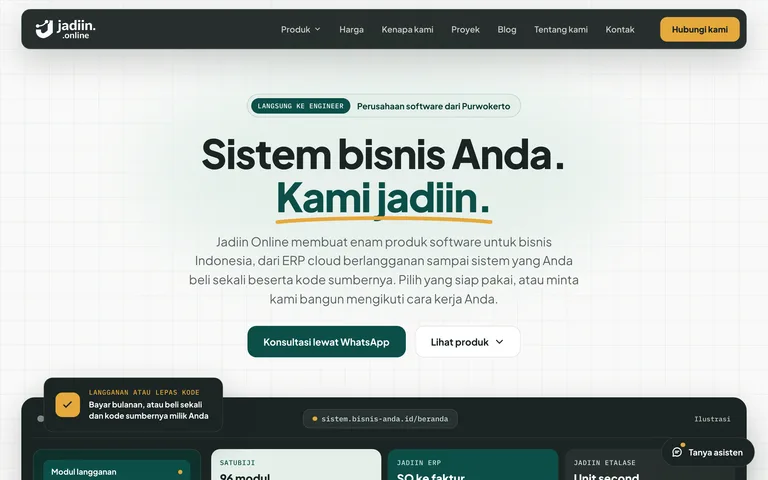
The software company I founded with Subani Charis Prasetya. It makes six products — satubiji, Jadiin ERP, Jadiin Etalase, Jadiin Villa, Sistem SPPG, and Jadiin Distributor — sold by subscription or with their source code, and builds custom systems. jadiin.online is its product and sales site.
Laravel 12 · PHP 8.3 · Blade · Alpine.js · +13
Jadiin ERP — 63-Module ERP Sold with Source Code
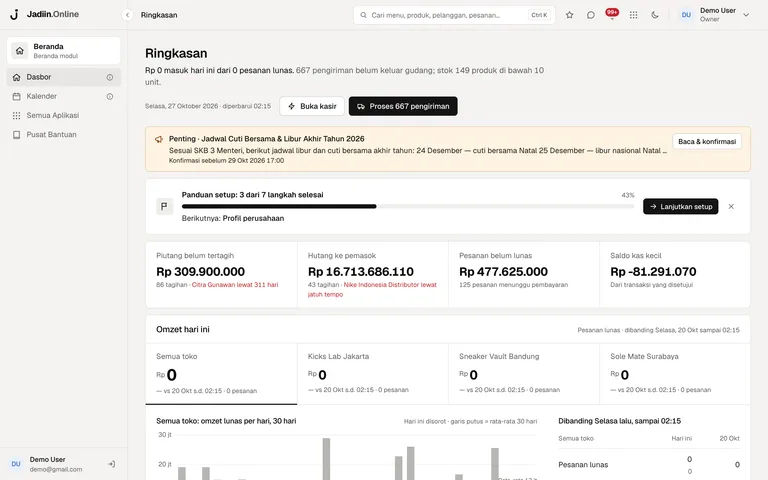
The main product of Jadiin Online: an ERP for distributors, importers, and business groups, with multi-warehouse stock, B2B documents from quotation to invoice, approvals, accounting, tax, payroll, POS, an online store, and 22 industry modules. 63 modules, sold once with the source code.
Laravel 12 · PHP 8.2 · Blade · Alpine.js · +15
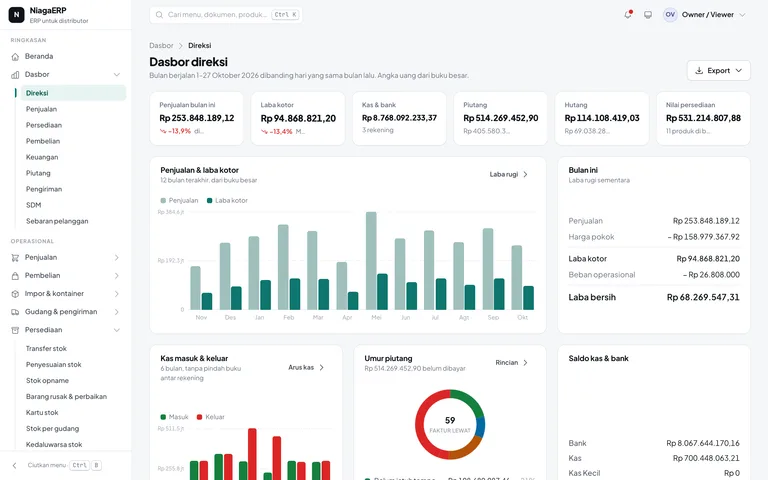
Jadiin Distributor — ERP for Distributors & Importers
A ledger-based ERP for distributors: quotations to invoices and payments, purchasing with three-way matching, container imports and pre-orders, multi-warehouse stock with batches and expiry, bank reconciliation, HR and payroll, CRM, fleets, and dashboards.
Laravel 13 · PHP 8.4 · Blade · Alpine.js · +5